Showing posts with label ICT. Show all posts

Saturday, June 16, 2012

Communication Protocol

Communications Protocols

A communications protocol defines the rules for sending blocks of data (each known as a Protocol Data Unit (PDU)) from one node in a network to another node. Protocols are normally defined in a layered manner and provide all or part of the services specified by a layer of the OSI reference model. A protocol specification defines the operation of the protocol and may also suggest how the protocol should be implemented. It consists of three parts:
  1. Definition of Protocol Control Information (PCI) format which forms the PDU header
  2. Definition of procedures for transmitting and receiving PDUs
  3. Definition of services provided by the protocol layers
A Protocol Data Unit
The PDUs exchanged have two parts: a header (also known as the Protocol Control Information (PCI)) and a payload (also known as a Service Data Unit (SDU)). The protocol does not define or constrain the data carried in the payload part. It does specify the format of the PCI, defining the fields which are present and the way in which the patterns of bits are to be interpreted.
A protocol also defines the procedures which determine how the PDU will be processed at the transmit and receive nodes. The procedures specify the valid values for the PCI fields, and the action be taken upon reception of each PCI value (usually based on stored control information). Examples of procedures which are implemented in protocols include:
The documents which define a protocol procedures are usually large and are seldom concrete (i.e. they may not be directly translated to executable programs). They typically define the actions to be taken when a particular condition is detected, but not how the condition is to be detected. It has been said that "Part of what makes a protocol mature is good implementation guidelines and folklore". The success of the TCP/IP protocol suite is largely due to the "industrial strength" code available in freely distributed reference implementations.
A protocol implemented by several processes (represented by circles) communicating using queues of PDUs, a shared information area (shown as a rectangle) and function calls between the processes (represented by arrows)
Protocols are usually implemented by writing a number of programs (processes) which communicate with one another through queues and by function calls. One or more timers are also usually required to ensure correct operation of the protocol. To start and stop timers, a protocol normally uses an interface to the computer's operating system. This interface is also used to request new (empty) buffers for received PDUs (or PDUs created by the layer) and to release buffers which are no longer needed by the protocol.
Protocols are generally described using a layered architecture known as the OSI reference model. Which abstracts the details of the protocol and allows a simple description of the service provided by the protocol to the protocol layer above and the service required by protocol layer from the layer below.
Examples of protocols include:

Wired Communication Media

wired communication
Due to wired communication, millions of people all over the world can ride the information highway with high-speed. Internet as a pure medium for provision of information has advanced to a communication medium between diverse devices and systems.
The availability of an internet access at any time and any place enables the usability of the internet in numerous consumer and producer goods. Even complex systems can be controlled, observed, configured and serviced.
In order to ensure the smooth interaction of the various communication requirements, elaborate net access techniques are necessary. That implies the provision of the essential infrastructure in the field of software and hardware.
We make your devices network-compatible by realizing the local and global networking of different devices - local or over the internet.
As a result of our experienced research and consulting, we offer you solutions in the field of:
  • Net access
  • Heterogeneous networks
  • Network management
  • Embedded internet
  • Java based software for embedded systems

Computer Communication

No market segment experiences innovation cycles as short as that of the peripheral area of PCs. A wide variety of communication protocols are being used around the computer, making it possible for computers to communicate with each other and with different peripheral units.
Requirements for these networks are immense as increasing amounts of digitized voice and data need to be transmitted over long distances and across the systems of different providers. Furthermore, the number of multimedia services is on the rise: fast internet accesses, video-on-demand or multi-channel video, multi player games as well as TV, data and voice services.
All these applications are channeled through the same networks simultaneously, reaching the individual user through a single set-top-box, and having to be distributed efficiently within a house or apartment. Only then is it possible to access a variety of services simultaneously.
The widespread access to the internet not only increases the desire to use higher transmission rates, but also the exchange of multimedia data in real-time using worldwide distributed applications.

In particular, our computer communication know-how covers the areas of:

  • Ethernet (10-Base-T, 100-Base-T, 1000-Base-T)
  • FireWire (also referred to as IEEE 1394)
  • USB (Universal Serial Bus)
  • IrDA (Infrared Data Association)

Network Access

Network access - often referred to as "the last mile" - builds the briidge between provider and user by different data transmission technologies.
Well-established data transmission techniques are usage of analog-to-digital modems, ISDN or xDSL-access. For the actual application, the technical implementation of these technologies is not as important as the appropriate usage.

We plan and realize network access via:

  • ISDN (Integrated Services Digital Network)
  • Analog-to-digital modem
  • xDSL - transmission procedure (Digital Subscriber Line)
  • Powerline (data transmission via low voltage and mains power supply)
  • Cable TV (data transmission via broadband cable of cable TV)
  • Satellite communication

Wireless communication media

Wireless communication :

Wireless communication is tranferred over a distance without the use of cable or wires . this may be one-way communication systems such as television or radio broadcasting, or two way communication systems such as machine-to-machine (M2M)

Wireless communications can bie via :

·         Radio frecuency
·         Microwave (i.e long-range and line-of-sight via antennas or short range communication )
·         GSM
·         GPRS
·         3G/HSDPA
·         GPS

Applications involve point-to-point, point-to-multipoint, cellular network and all other wireless network communications .


Point-to-point communication

A point-to-point link is a communication medium with two endpoints. Data can be tranferred from both computers either end. The connection between the computer and the communication medium (GSM/GPRS Modem or GSM/GPRS Router ) is generelly through a RS-232 interface but ethernet port are also used .

Point-to-point multipoint  communication

A point-to-multipoint link is the communication between a computer and a centrel host where connections can be made from various end-point at different locations. Data can be trabferred from the computer via the centrel host over wireless networks such as GSM,GPRS, and 3G .

Cellular network

Acellular network is a radio network made up of a number of cells, each served by at least one fixed-location transciever, the cells can be join together to provide radio radio coverage over a wide geographic area. This enables portable transciever such as mobile phone to communications with ech other .

Wireless network

A wireless network refers to any type of computer or machine-to-machine(M2M) link communicating without the need of cable or wires . this is commonly associated with telecommunication networks that can be interconnections between nodes are implemented wielessly .


Computer network

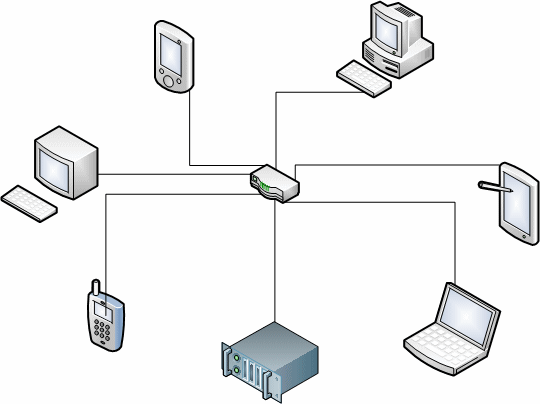
A computer network can also consist of, and is usually made for, more than two computers:


Characteristics of a Computer Network


The primary purpose of a computer network is to share resources:
  • You can play a CD music from one computer while sitting on another computer
  • You may have a computer that doesn’t have a DVD or BluRay (BD) player. In this case, you can place a movie disc (DVD or BD) on the computer that has the player, and then view the movie on a computer that lacks the player
  • You may have a computer with a CD/DVD/BD writer or a backup system but the other computer(s) doesn’t (don't) have it. In this case, you can burn discs or make backups on a computer that has one of these but using data from a computer that doesn’t have a disc writer or a backup system
  • You can connect a printer (or a scanner, or a fax machine) to one computer and let other computers of the network print (or scan, or fax) to that printer (or scanner, or fax machine)
  • You can place a disc with pictures on one computer and let other computersaccess those pictures
  • You can create files and store them in one computer, then access those files from the other computer(s) connected to it


Based on their layout (not the physical but the imagined layout, also referred to as topology), there are various types of networks. A network is referred to as peer-to-peer if most computers are similar and run workstation operating systems.
In a peer-to-peer network, each computer holds its files and resources. Other computers can access these resources but a computer that has a particular resource must be turned on for other computers to access the resource it has. For example, if a printer is connected to computer A and computer B wants to printer to that printer, computer A must be turned On.

Related Posts Plugin for WordPress, Blogger...